Method
The Ohio State University · University of Maine
Morphological traits are physical characteristics of biological organisms that provide vital clues on how organisms interact with their environment. Yet extracting these traits remains a slow, expert-driven process, limiting their use in large-scale ecological studies. A major bottleneck is the absence of high-quality datasets linking biological images to trait-level annotations.
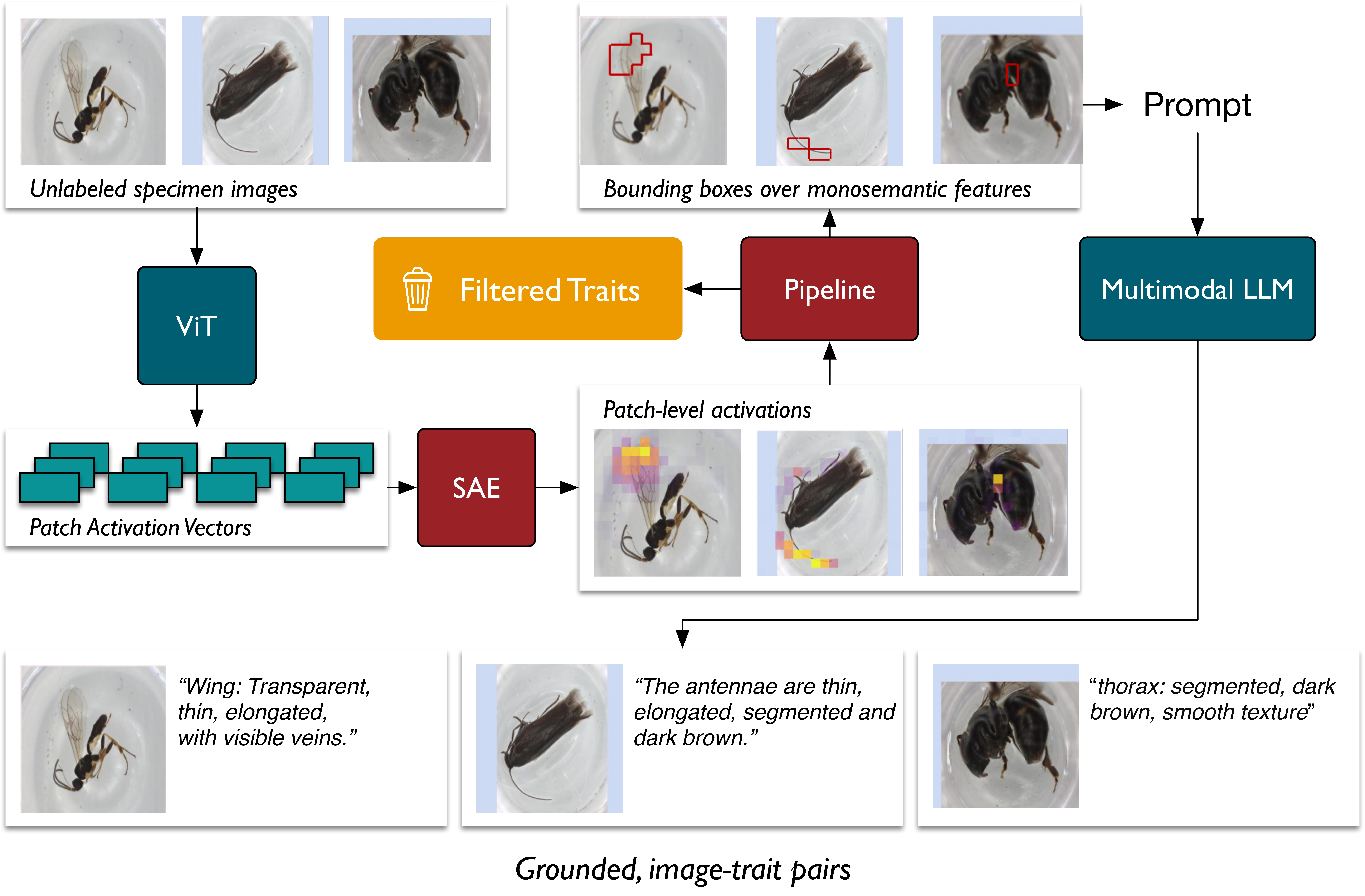
In this work, we demonstrate that sparse autoencoders trained on foundation-model features yield monosemantic, spatially grounded neurons that consistently activate on meaningful morphological parts. Leveraging this property, we introduce a trait annotation pipeline that localizes salient regions and uses vision-language prompting to generate interpretable trait descriptions.
Using this approach, we construct Bioscan-Traits, a dataset of 80K trait annotations spanning 19K insect images from BIOSCAN-5M. Human evaluation confirms the biological plausibility of the generated morphological descriptions. We assess design sensitivity through a comprehensive ablation study. By annotating traits with a modular pipeline rather than prohibitively expensive manual efforts, we offer a scalable way to inject biologically meaningful supervision into foundation models, enable large-scale morphological analyses, and bridge the gap between ecological relevance and machine-learning practicality.
We release Bioscan-Traits, a large-scale morphological trait dataset for insects, constructed automatically using our pipeline.
Available on Hugging Face. Built on top of the BIOSCAN-5M insect image collection, each annotation links an image region to an interpretable morphological trait description generated by our pipeline.
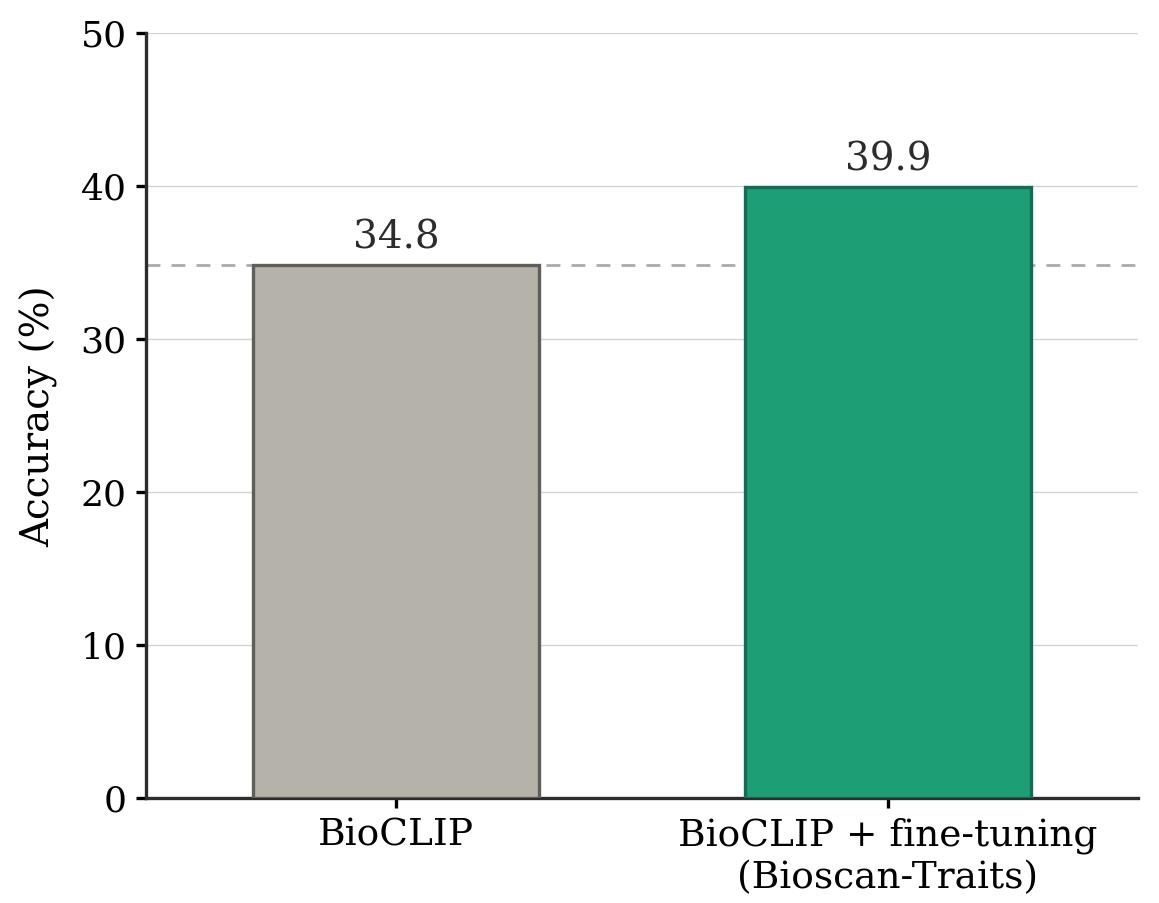
To validate the utility of Bioscan-Traits, we fine-tune BioCLIP on our dataset and evaluate on a held-out insect classification benchmark. Fine-tuning with trait-annotated data yields a +5.1% improvement in accuracy over the BioCLIP baseline, demonstrating that our automatically generated morphological annotations provide meaningful biological supervision.
If you find this work useful, please cite our paper:
@inproceedings{pahuja2026automatic,
  title     = {Automatic Image-Level Morphological Trait Annotation
               for Organismal Images},
  author    = {Pahuja, Vardaan and Stevens, Samuel and East, Alyson
               and Record, Sydne and Su, Yu},
  booktitle = {The Fourteenth International Conference on
               Learning Representations},
  year      = {2026},
  url       = {https://openreview.net/forum?id=oFRbiaib5Q}
}
This research was supported in part by NSF CAREER #2443149, NSF OAC 2118240, and an Alfred P. Sloan Foundation Fellowship. Computational resources were provided by the Ohio Supercomputer Center.
S. Record and A. East were additionally supported by the US National Science Foundation’s Award No. 242918 (EPSCOR Research Fellows: Advancing NEON-Enabled Science and Workforce Development at the University of Maine with AI) and by Hatch project Award #MEO-022425 from the US Department of Agriculture’s National Institute of Food and Agriculture. Any opinions, findings, and conclusions or recommendations expressed in this material are those of the author(s) and do not necessarily reflect the views of the National Science Foundation or the US Department of Agriculture.
We thank colleagues in the OSU NLP group for valuable feedback. This work was in part conceived at Funcapalooza.